Purchase-to-Pay in 2025: Six Real Shifts Redefining P2P, AP & Shared Services
By 2025, Purchase-to-Pay (P2P) had become a far more visible and consequential function within finance. Cash pressure, rising risk, and higher expectations from the business meant that decisions made in Accounts Payable and Shared Services increasingly influenced outcomes leaders cared about most: liquidity, operational continuity, and confidence in financial data.
As a result, the conversation shifted. Instead of focusing on which technology to deploy next, many organizations began reassessing whether their P2P processes, controls, and data foundations were actually capable of supporting the business at scale.
AI Automation in Purchase-to-Pay: Why P2P Technology Exposed Process Weaknesses and Data Quality Gaps
In 2025, AI started telling a clearer story. The results organizations saw had far less to do with the tools themselves and far more to do with the data behind them. Where data was structured, reliable, and complete, automation moved forward. Where it wasn’t, limitations surfaced quickly.
For many Shared Service and Accounts Payable teams, that gap was familiar, even if it hadn’t always been visible.
After extensive investment in OCR, workflow automation, RPA, chatbots, and GenAI assistants, expectations were high. As automation expanded, it began to reveal the manual corrections, assumptions, and workarounds that had quietly kept things moving.
Deloitte’s 2025 Global Business Services (GBS) Survey noted how organizations are “still constrained by inconsistent processes and unreliable data.” When automation is layered onto that reality, it inherits the same limitations.
Gartner observed a similar pattern in 2025, particularly as AI moved beyond pilots and into legacy workflows. The challenge wasn’t the tools themselves, but the complexity of embedding them into processes that had evolved over time, often without full documentation or consistency. The result was performance that varied more than many organizations expected.
Operationally, the impact was immediate:
- Data inconsistencies surfaced immediately, particularly where vendor records, tax fields, or PO data were incomplete or misaligned across systems.
- Routing and approval gaps became visible, as AI workflows highlighted variations in how similar invoices were handled across countries or business units.
- Exception volumes remained high, largely driven by upstream inputs that lacked standardization.
- Decision steps that relied on tribal knowledge came into focus, as automation required teams to document choices that had never been formally defined.
- Fragmentation across systems created bottlenecks, with automation revealing where information failed to move smoothly between ERP, procurement, and supplier systems.
- AI often functioned as an enhanced control layer rather than a transformational engine, augmenting tools like OCR while remaining dependent on the quality and consistency of upstream data.
2025 didn’t bring the frictionless P2P workflows many hoped for.
The result was a shift in day-to-day work. AP and P2P teams spent less time pushing transactions through and more time interpreting, correcting, and resolving issues created earlier in the chain. AI didn’t remove effort; it redirected it.
Instead of focusing on what to automate next, many leaders began asking whether their datal – and the way it fed the process – was ready for automation at all. In 2025, that question defined who moved forward and who automated the noise.
Shared Service Centers in P2P Operations: Strategic Transformation from Cost Reduction to Business Value Creation
In 2025, Shared Service Centers finally stepped out of the back office.
What had long been viewed as a transactional cost-reduction machine became, for many organizations, one of the most influential levers for cash discipline, compliance, risk management, and supplier health.
The shift was visible across the industry.
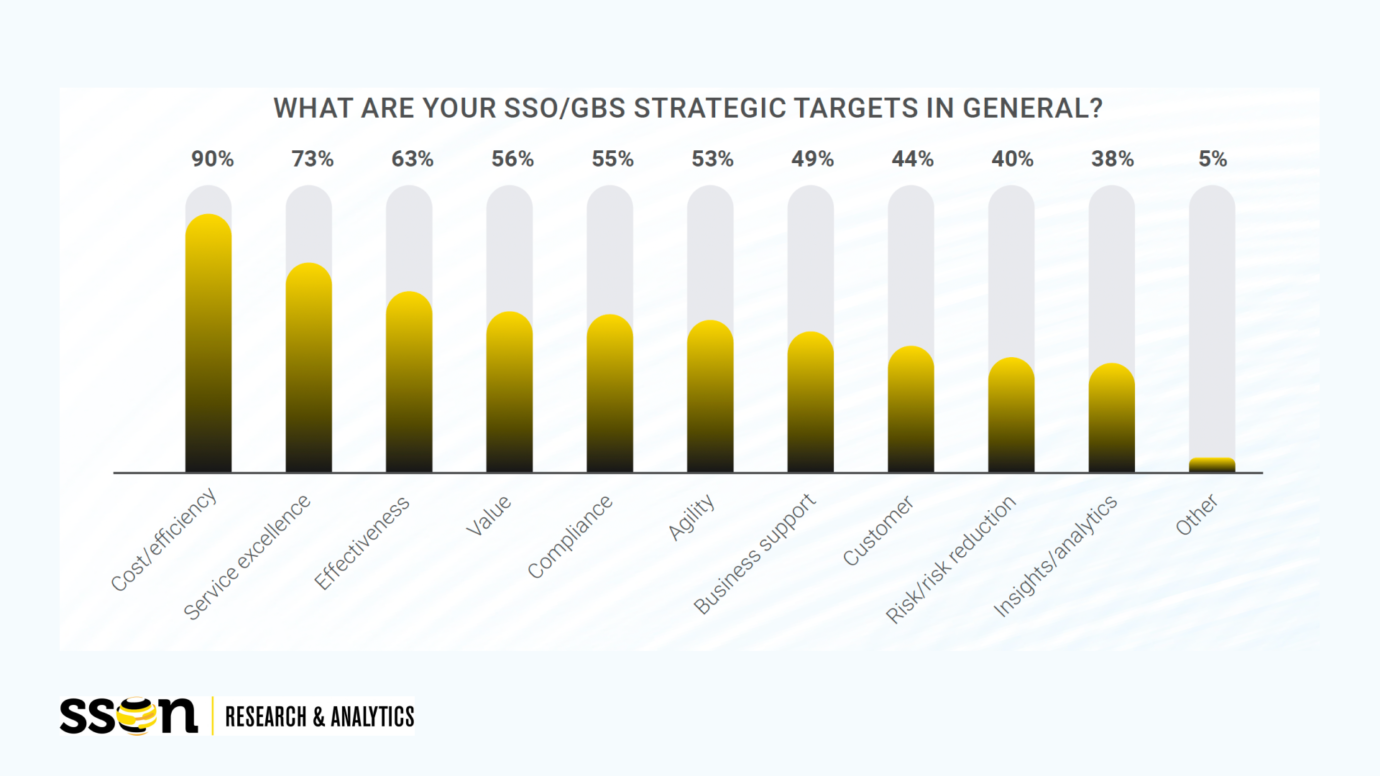
According to the 2025 State of the Shared Services & Outsourcing Industry Global Market Report, more than half of Shared Services and GBS leaders say their organizations are now primarily focused on delivering business value, not just efficiency or cost savings. While 90% still list cost optimization as a target, 63% now prioritize ensuring processes and workflows deliver measurable outcomes rather than simply moving transactions.
This reflects what we’ve seen in practice.
In 2025, SSCs became responsible for the areas that determine how healthy a company really is: cashflow visibility, working-capital optimization, compliance, supplier experience and prevention of financial leakage. Daily decisions around invoices or payments were suddenly tied directly to broader financial and operational metrics.
That shift changed the tone in leadership conversations.
SSCs were no longer asked, “How many invoices did you process?” but instead:
- “How well are we controlling spend?”
- “Are we reducing risk?”
- “Do we understand our suppliers?”
- “Are our processes supporting liquidity?”
In other words: Shared Services became strategic.
The focus moved from task completion to outcomes such as protecting cash, reducing exposure, improving supplier reliability and strengthening operational resilience.
This raised expectations (and stakes)for every process inside Purchase-to-Pay.
Purchase-to-Pay Fraud Prevention: Why Advanced Payment Controls Became Essential for Finance Teams
2025 was also the year when fraud didn’t just increase, it evolved.
The attacks reaching finance teams were different: more targeted, more researched, and more convincing.
Accounts Payable teams saw bank-detail change requests referencing real invoice numbers, supplier emails that matched the tone and timing of genuine correspondence. Impersonation attempts mirrored internal communication patterns closely enough to blend in.
These weren’t opportunistic attacks. They reflected a clear understanding of how Purchase-to-Pay actually works.
The European Payments Council’s “2025 Payment Threats and Fraud Trends Report” highlighted social-engineering and impersonation as some of the most prominent and damaging attack patterns across payment flows, noting that fraudsters were increasingly targeting processes rather than technology.
At the same time, the Tietoevry Banking 2025 Payment Fraud Report showed a significant rise in attempted digital payment fraud across Europe, reinforcing what many P2P teams were already feeling: the threat had become persistent, organized, and sophisticated.
These attacks exposed weaknesses that had existed for years:
- Vendor-master processes built on trust rather than verification
- Bank-detail changes approved too quickly or informally
- Approval chains buried in email threads
- Onboarding processes inconsistent across countries or teams
And the consequences became harder to ignore.
Every small gap – a missing callback, a rushed update, a single person able to change supplier details – now carried outsized risk.
It didn’t take long for payment controls to move from an AP checklist to a CFO and Board-level priority. In leadership meetings, efficiency was no longer the first question. Exposure was.
This shift triggered rapid changes across organizations:
- Multi-step verification for all bank-detail updates
- Redesigned and standardized supplier onboarding
- Re-validation of legacy vendor data
- AP empowered to pause or escalate suspicious payments
- “Trust but verify” established as the default posture
2025 made one thing unmistakably clear: speed and automation mean nothing if the payment leaving the business isn’t protected.
Working Capital Optimization Through P2P: How Accounts Payable Strategy Drives Cash Flow Management
In 2025, cash got tight again.
Higher interest rates, supply-chain volatility and slowing customer payments meant organizations had to look more closely at how money was flowing in and out of the business. And suddenly, the Accounts Payable function, usually measured on speed and efficiency, found itself at the center of the liquidity conversation.
The European Payment Report 2025, based on responses from more than 9,000 executives across Europe, showed that late customer payments reached levels that were putting real strain on working capital. Many businesses reported that a noticeable share of their annual revenue was being paid late, making cash planning far harder and far riskier than in previous years.
At the same time, McKinsey’s 2025 Global Payments Report noted that payment strategies were evolving from “process efficiency” toward liquidity management and financial resilience, reflecting the tougher macroeconomic environment finance teams were operating in.
For P2P teams, the impact of this shift was immediate.
Conversations that used to focus on invoice cycle times or cost-per-transaction suddenly expanded into questions like:
- “Are we paying suppliers too early?”
- “Which suppliers should we prioritize to protect operations?”
- “Can we negotiate better terms or early-payment discounts?”
- “What does our liability exposure look like this week, not next month?”
The operational rhythms of AP began to align much more closely with treasury, FP&A and procurement.
Teams found themselves managing not just the process of paying bills, but the timing of paying bills, and the financial consequences of getting that timing wrong. Paying too early put pressure on cash reserves; paying too late risked supplier relationships, continuity, or even compliance breaches.
Working capital wasn’t just a treasury concept anymore. It became part of everyday decision-making inside P2P. And that redefined the role of AP, not as a processor of payments, but as a contributor to financial resilience.
Vendor Reconciliation Challenges in Purchase-to-Pay: Addressing Critical P2P Process Blind Spots
Even as automation matured across invoice processing, approvals and payment controls in 2025, statement reconciliation continued to stand apart as one of the most time-consuming and least automated activities in Purchase-to-Pay. And it increasingly influenced how confidently teams could execute the payment strategies described in the earlier trends.
This is not the result of poor discipline or teams failing to follow the process. It is a structural challenge.
The vendor environment is inherently complex, and in Transparent’s experience, complete statement reconciliation is not possible through tools alone. The process depends on information that sits outside ERP systems and requires interpretation rather than simple matching.
Several factors made full automation elusive in 2025:
- Supplier-side complexity: suppliers use different ledgers, naming conventions and offsetting practices, and issue statements at business-unit, regional or group level.
- Variation across markets: the format and structure of statements differ across countries, business units and document types.
- Dependence on aligned data: matching engines require clean, structured and consistent data on both sides which is rarely the case in practice.
- Context and language: resolving discrepancies often requires understanding how a supplier applies credits or offsets, and sometimes navigating language-specific or region-specific terminology.
- Coverage limits: automated systems tend to detect straightforward mismatches, while the most financially relevant issues sit in unstructured, cross-period or ambiguous items that require judgement.
As a result, even advanced reconciliation tools can only partially cover the work, leaving unresolved discrepancies that affect payment timing, liability accuracy and supplier communication.
As leaders enter 2026, they should be asking themselves:
- “Do we have a clear and reliable picture of what we actually owe our suppliers?”
- “Are payment delays driven by strategy or by uncertainty in supplier balances?”
- “Do unresolved statement differences hold us back from making confident payment and cash-flow decisions?”
End-to-End P2P Process Ownership: Implementation Strategy and Organizational Structure Best Practices
“End-to-end” process visibility and improvement have been in transformation roadmaps for years.
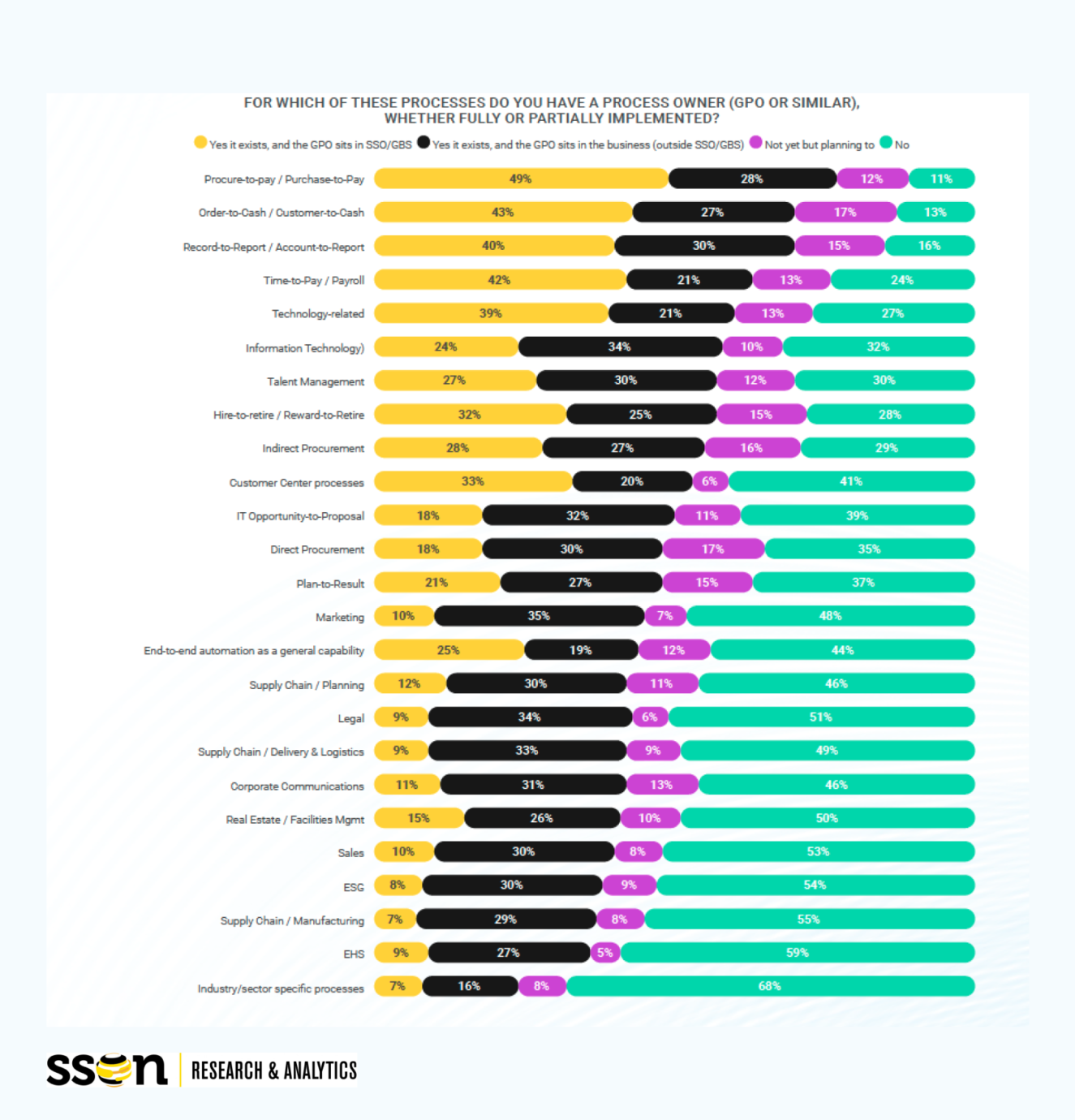
By 2025, it became the norm. According to SSON Research & Analytics, 76% of organizations now have a P2P Global Process Owner (GPO) in place, either within Shared Services/GBS (49%) or elsewhere in the business (27%). Another 12% are planning to introduce the role.
From a structural standpoint, end-to-end ownership had never looked stronger.
What became clearer in 2025, however, was the gap between structure and impact.
Gartner’s Get Started With Finance Global Process Ownership report highlights the core problem bluntly: in most organizations, “everyone, and thereby no one, is accountable for the process.” Even where GPOs exist, the role is often too fragmented or ambiguous to deliver real end-to-end governance. Gartner notes that transformation leaders “struggle to implement the global process owner role” and face overwhelming variation in how responsibilities are defined.
EY’s Future of GPO insights point to the same tension. Many GPO roles were originally designed to coordinate across functions, not to govern them. As a result, GPOs often lack the mandate to challenge entrenched silos, redesign upstream steps, or enforce global standards. Accountability exists, but influence does not always follow.
Across organizations, these challenges manifested in consistent ways:
- Process decisions remained local, owned by regions or business units rather than by a central authority.
- Functional silos persisted, producing multiple versions of “how P2P works.”
- Systems remained fragmented, making unified data models difficult to enforce.
- Operational responsibilities crowded out transformation, with Gartner warning that service delivery tasks can “crowd out the focus on process design,” limiting impact.
Across organizations, this showed up in familiar ways:
- Process decisions continued to sit locally, owned by regions or business units rather than a central authority
- Functional silos persisted, creating multiple interpretations of “how P2P works”
- Fragmented systems made unified data models difficult to establish
- Day-to-day service delivery crowded out transformation work, echoing Gartner’s warning that operational responsibilities can overwhelm process design efforts
Despite the intent, few GPOs had the authority, visibility, or organizational alignment needed to shape the full P2P lifecycle. Even basic elements, such as consistent three-way matching or global coding standards, remained uneven across large enterprises.
By 2025, this gap was harder to ignore. The ambition for end-to-end ownership was clear. The roles were increasingly in place. But without a mandate that truly spans functions, systems, and geographies, “end-to-end” remained an aspiration rather than a lived reality for many organizations.
2025 was the year reality set in, and leaders adjusted.
The organizations that moved forward in 2025 shared a few common traits. They:
- Took automation seriously, but only after addressing process weaknesses
- Positioned SSCs and GBS as contributors to business value, not just efficiency
- Strengthened controls in response to rising fraud risk
- Treated AP and P2P as levers in cashflow and working-capital management
- Used their own data to identify and correct recurring issues before they turned into losses
If 2023 and 2024 were defined by pilots and experimentation, 2025 was about operating in the real world. Discipline mattered. Risk was tangible. And value had to be proven, not promised.
Purchase-to-Pay Best Practices: Strategic Action Points for 2026 P2P Optimization
Strengthen P2P Process Foundations Before Implementing Advanced Procure-to-Pay Automation Solutions
Automation only performs as well as the process beneath it. 2026 should start with eliminating defects in vendor data, PO discipline, exception workflows and approval chains – the areas automation exposed most clearly.
Transform Shared Service Centers from Cost Processing to Strategic P2P Value Creation
Shift goals from efficiency alone to measurable impact on liquidity, risk, supplier experience and working-capital outcomes. This aligns Shared Services with the way leadership now evaluates performance.
Implement Automated P2P Fraud Prevention Controls Beyond Manual Payment Verification
Fraud patterns now target processes, not technology. 2026 requires multi-step verification, clear ownership of bank-detail changes, and consistent onboarding built into workflows, not bolted on afterwards.
Optimize Payment Timing as Strategic Working Capital Management, Not Operational P2P Processing
AP should work alongside Treasury and FP&A to shape when payments are made, not just how they are processed. This means evaluating terms, prioritizing suppliers, and linking payment runs to working-capital objectives.
Resolve Vendor Reconciliation Issues Early in Purchase-to-Pay Cycle Through Process Integration
Statement discrepancies often surface too late, slowing payment decisions and weakening supplier communication. 2026 calls for earlier visibility of supplier-reported balances, clearer reconciliation ownership, and better escalation paths when supplier and internal data diverge.
Integrate P2P Process Confidence Metrics into Purchase-to-Pay Performance Measurement
Beyond speed and cost, organizations should measure:
- data reliability
- exception predictability
- reconciliation accuracy
- supplier clarity
These metrics determine whether automation, controls and payment strategies can work as intended.
How Transparent Can Help
The challenges that surfaced in 2025 are not theoretical. They show up daily in invoice handling, payment decisions, and supplier communication. This is where Transparent supports finance and Shared Services teams. Transparent works alongside finance, AP and Shared Services teams to uncover where payment processes break down in practice, and why. We focus on the gaps between data, process and automation that create errors, rework and risk.
Increase P2P Process Confidence and Operational Visibility
We analyze real invoice and payment activity to identify where inconsistencies arise, what drives them, and whether the root cause sits in system setup, process design or day-to-day execution. This helps teams improve payment accuracy, reduce manual intervention and prevent the same issues from recurring.
Assess Whether P2P Automation is Delivering Expected Results
Automation only adds value when it behaves as intended. We review automated payments and exception patterns at scale to understand where automation supports the process, and where it amplifies upstream defects, so teams know what to fix before scaling further.
Prevent Payment Issues Before They Impact Cash Flow
Our software, Qlarity, analyses invoice and payment patterns to surface early warning signs such as duplicate invoices, posting errors or unusual payment behavior, helping teams intervene before issues escalate.
Bring Clarity to Supplier Statements and Outstanding Balances
We support statement reconciliation by working directly with suppliers, reviewing statements against internal records, and interpreting discrepancies that tools alone can’t resolve. This uncovers unposted credits, payment errors and balance differences that affect payment timing and confidence.
Strengthen Vendor Master Data Quality at the Source
Inconsistent vendor data remains a major driver of AP errors and failed automation. We clean up duplicate and outdated records and improve data governance to reduce risk and prevent repeat issues.
Detect P2P fraud patterns and payment anomalies with automated controls
By analyzing payment patterns and control gaps, we identify suspicious transactions, overpayment risk and areas where weak controls create exposure before they turn into losses.
Strengthen procure-to-pay compliance through contract review automation
We help teams identify payments that don’t align with contractual terms, particularly where agreements are complex or poorly documented, so attention is focused where risk is most likely to arise.
Transparent doesn’t replace your systems or your teams.
We help you see what’s really happening, so improvements to P2P, automation and payment strategy are grounded in reality.